










How to Check a Microwave Oven Transformer? We’ve noticed that many people ask this question on social media, and as a transformer manufacturer, Partopia Transformer is more than happy to help answer anything related to transformers. In this blog, we’ll walk you through the test step by step with images and explanations. We’ll also share a very clear video tutorial, so if the images and text still aren’t clear enough, you can follow along with the video as well. (If you need to customize or purchase microwave oven transformers in bulk, feel free to reach out to us — as an original factory, we can offer very competitive prices.)
How to Check a Microwave Oven Transformer with a Multimeter? – Guidance for Beginners
Step 1: Safety preparation
Before you start microwave transformer test, be sure to disconnect the microwave oven from the power supply and discharge the high‑voltage capacitor to prevent electric shock.
🟥 WARNING – HIGH VOLTAGE
🔌 Disconnect Power First
Always unplug before inspection or service.
⚡ Electric Shock Hazard
High voltage may remain inside even after unplugging. If you are not trained in electrical repair, do not open the unit.
🔋 Discharge Capacitor
High-voltage capacitor must be safely discharged before touching internal parts.
👷 Qualified Personnel Only
Service and internal inspection must be performed by trained technicians.
Step 2: Visual and Smell Check
Before using any tools, we can do a simple visual inspection:
1) Check for burn marks
Look for blackened areas, bubbling, or burn marks on the transformer body or around the windings. These are usually signs of overheating or internal short circuits.
2) Smell for burning odors
If you notice a strong burnt or electrical smell, it may indicate damaged insulation or overheated windings.
Step 3: Measure Resistance (Power Off)
This is the most common and safe initial test.
A microwave transformer typically has three windings: the Primary winding (220V side), Filament winding (magnetron filament), and High-voltage winding (output side).
The images below label them very clearly, so once you look at it, you will be able to find the position of each coil.


OK, now you find the windings. Let’s take out the multimeter and set it to 600‑ohm.

First, we test the primary winding. For the primary winding (220 V side), the resistance is very low, generally in the range of about 0.1 ohms to a few ohms, and on some models it may be close to 4–5 Ω. In most cases, as long as the reading is a low value and clearly neither open circuit nor tens of ohms or higher, it’s basically fine.
Here, the result I tested is 2.2 ohms, so it’s normal.
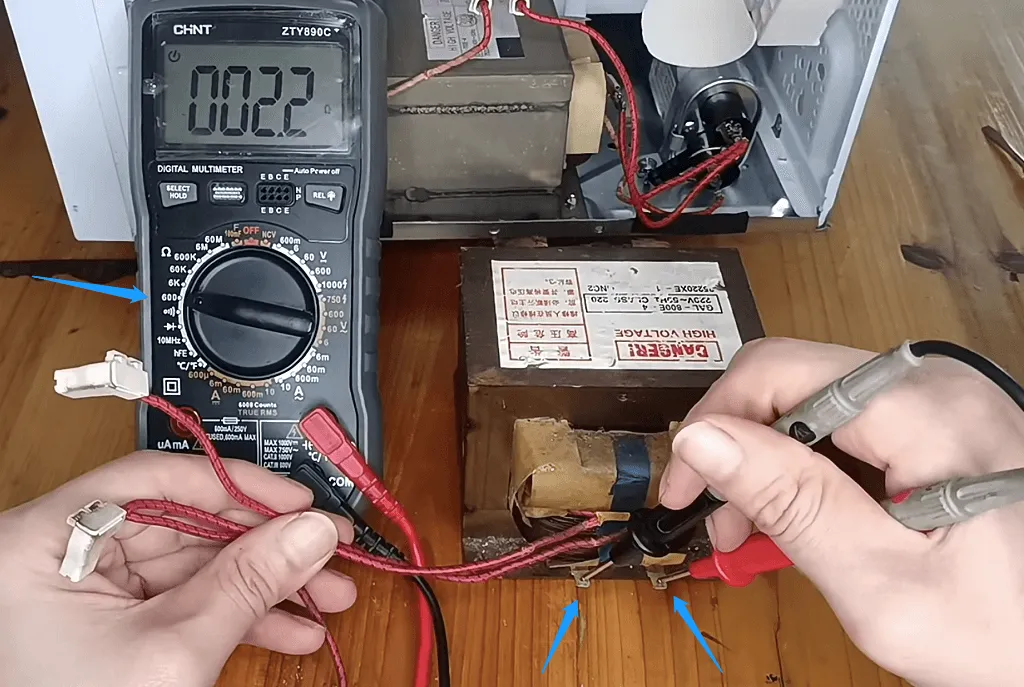
Next, test the filament winding. The filament winding is usually less than 1 ohm. The filament winding for the magnetron has an extremely low resistance, usually under 1 Ω, so on a lot of multimeters it will look almost like 0 Ω, which may seem like a short, but that’s actually normal.
Here, it reads 0.2 ohms, hence also normal.

Then test the high‑voltage winding. The high‑voltage winding usually falls anywhere from a few dozen ohms up to a few hundred ohms, and you’ll often see something in the 50–350 Ω range. Different models can vary quite a bit though, so the best thing is to go by the typical values given in the service manual for that particular microwave.

Test result guidelines
Open circuit:
If the multimeter displays ∞ (infinite resistance), the winding is open (burned out).
Short circuit:
If the multimeter shows 0 ohms or an abnormally low resistance (e.g. <10 ohms on the high-voltage winding), this indicates internal insulation breakdown.
Step 4: Voltage Test (Power ON – Qualified Personnel Only)
⚠️ This step must be performed by trained professionals only.
High voltage is present during this test and can cause serious injury or death.
If all resistance readings are normal and suitable high-voltage test equipment is available:
Filament voltage: approximately 3–4 V
High-voltage output: approximately 1800–2100 V
If the measured voltage is significantly lower than this range, the transformer may be deteriorating, or the magnetron may be faulty.
Video
You may also refer to this video(not made by us) for a clear and detailed explanation of the procedure.
Hope this blog post helps you if you need to test a microwave oven transformer!
Dear Customers,
We are Partopia Transformer, a custom microwave over transformer manufacturer and factory in China. We specialize in high-performance bulk customization services—direct from our factory, ensuring reliable quality, stable delivery timelines, and competitive pricing. We’d be pleased to learn about your specific requirements to explore a long-term strategic partnership. Let’s discuss your microwave oven transformer custom needs!